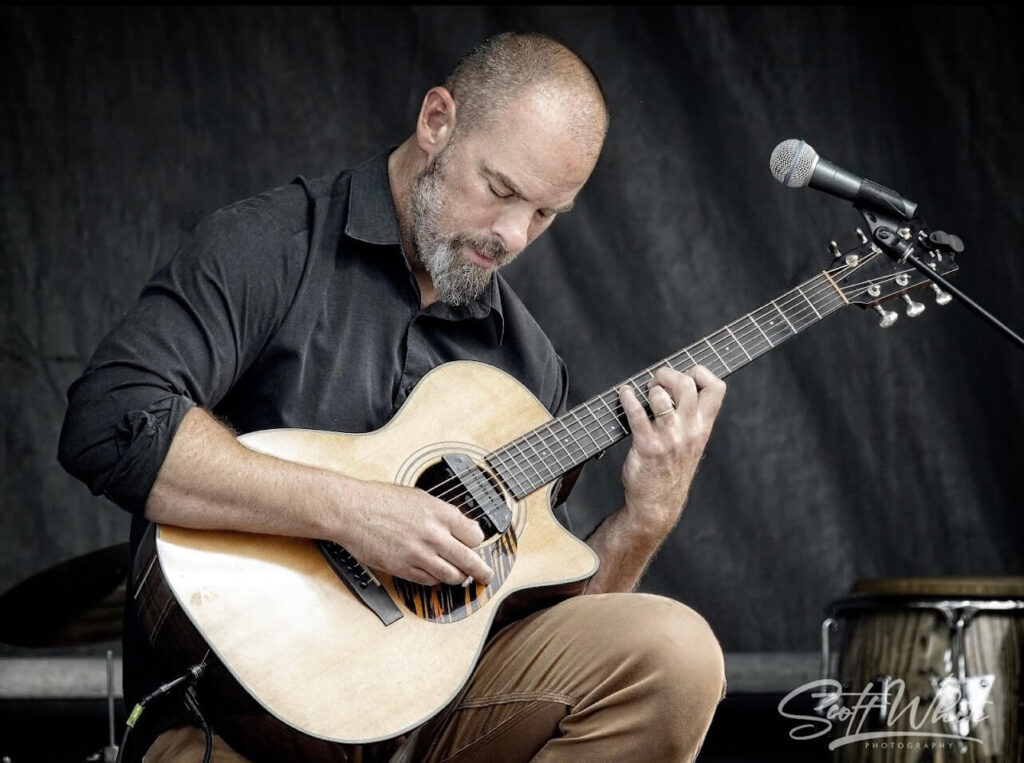
My Story
I was lucky enough to be born into a musical family where singing and playing music was as common as going for a walk. I played my first gig with my dad when I was two years old. I was on the piano, he was on guitar, and together we performed Twinkle Twinkle Little Star at a family wedding anniversary celebration. I have absolutely zero recollection of that gig. But I can only imagine the clapping, the cheering, and the happiness that must have been in the room. And somehow, I think it was etched into my soul that music brings people together.
My father, Manfred, and my mother, Joanna, absolutely loved music. My dad was a professional musician who toured Western Canada with great success. But the thing I’ll always remember about him wasn’t how good he was. It was the joy on his face when he played. It never looked like work.
Somebody asked me many years later how my father taught me guitar. And I said, that’s just it. He never tried to teach me. I saw it modelled. It was just part of our life.
My dad’s band rehearsed in our basement, and when nobody was around I would go down there and explore everything. The drums, the pianos, keyboards, shakers, marimbas, bass guitars, microphones. You name it. It was like having my own personal musical playground.
When I was seven or eight, I taught myself an entire Beach Boys album on the drums by cranking my parents’ stereo so loud on the second floor that I could hear it all the way down in the basement. Mom and Dad weren’t particularly impressed when they came home. LOL. Although I remember my mom being somewhat shocked that I could actually play Beach Boys songs on the drums, having never had a lesson.
Another pivotal memory was sitting at our old acoustic piano and teaching myself how to play Jump by Van Halen. My grandma, who was a missionary and spent a great deal of time overseas working in various parts of Africa, happened to be home for a visit. She came over, sat down beside me, listened for a moment and told me I was doing it wrong.
“Where’s the sheet music?” she asked. I looked at her, completely perplexed. “What do you mean, sheet music?” She proceeded to pull out an old dusty book and started trying to teach me how to play Christmas carols. That didn’t go particularly well. I wasn’t interested in Christmas carols. I wanted to play Van Halen. And I could already play the song. So why was I doing it wrong? Looking back, I think that was one of my first experiences with the strange idea that there’s a proper way to learn music, even when someone is already making music.
Another key memory came when I was going into Grade 7. I must have been about 11 years old. My mom and dad said, “Well, you’re a musician, so figure out which instrument you want to play.” The problem was, there was no option for guitar or drums. So I chose the saxophone.
My dad found me a used alto saxophone at a garage sale. He showed me how to put the reed on the mouthpiece, how to blow a single note, and basically said, “There. Go figure it out.” And I did. I taught myself the theme from The Pink Panther, A&W, O Canada, Happy Birthday, and countless other familiar melodies that I could use to entertain my friends. I was so proud of that saxophone.
On my first day of Grade 7, I was the only kid in the class who actually owned an instrument. There must have been about 40 of us, and the teacher was late. So naturally, I pulled out my saxophone and started entertaining everybody. The class was loving it. Everyone was looking at me, smiling, laughing and having a great time. And then the teacher walked in. She absolutely lost it. She thought I’d stolen the saxophone from the band room, accused me of taking it without permission, told me to put it away and immediately gave me a detention.
Then she walked up to the blackboard, drew a circle and announced, “This is a whole note. It’s worth four beats.” And from that moment on, I honestly failed just about every theory test you can imagine.
The weirdest thing was that I was one of the better players in the class. She couldn’t understand how I could play the music but not read it. Sometimes my music book was literally upside down. She’d point to a note on the page and I couldn’t tell you whether it was an E, a D, a Z or an L. None of that seemed to matter to me. I could hear the music. Those little black dots on a page seemed so restrictive compared with the joy I got from freely playing melodies. I would routinely get 20 out of 20 on the playing tests and zero out of 20 on the theory tests.
Three years of this, and I almost quit music altogether. But I stuck with it. And then something happened that changed my life. I went to a school talent show.
A kid named Colin Sharp, who was actually a year younger than me, got up on stage with some older students from the senior high school across the road. They were playing original music that Colin had written. I’ll never forget it. It was like that scene from Back to the Future. Chills ran down my spine. I couldn’t believe that somebody in my school could actually play the guitar, let alone write their own music. I had to understand how this worked. And so began my journey with the guitar at around age 14.
Everything changed from that point onwards. I became completely enamoured with the instrument. First I was practicing an hour a day. Then two. Then four. Six. You guessed it, eight, ten, sometimes twelve hours a day. I was obsessed. I dreamt about it. I thought about it constantly. I couldn’t get enough.
Kirk Hammett from Metallica, Stevie Ray Vaughan, Steve Vai, Joe Satriani, Eddie Van Halen and, of course, my hero Jeff Beck. Eventually Paco de Lucia, Derek Trucks, David Gilmour, Marty Friedman, and on and on it went. I studied every genre I could get my hands on. Rock, blues, jazz, classical, flamenco, bluegrass, folk, country. I wanted to understand it all.
But somewhere along the way, another passion started taking shape. Teaching. I was barely 16 years old when I got my first teaching job at Cheam Music in Chilliwack. I was hired by a fellow named Gordy Saline. Gordy actually paid me to sit in the music store and play guitar. He figured my hard rock and metal chops would attract other teenagers and help sell amplifiers. I couldn’t believe somebody was paying me to sit around and play guitar all day.
Eventually I got my first student. He was a kid not much younger than me, and we both loved Metallica. We hit it off immediately. This was easy!
But then I got my second student. His name was Robert, and he was a man in his 40s. One day Robert asked me why we called it a G chord. I had absolutely no idea. So I said, “I’ll tell you what. I’m going to go learn why it’s called a G chord, and I’ll show you next week.”
To my astonishment, Robert actually showed up the following week. My dad had given me just enough information to explain it. Something about G, B, D, root, third and fifth. I repeated what he’d told me to Robert. Robert looked perplexed and said, “All right. Good enough for me.” And away we went, learning chords and playing songs.
I really didn’t know what I was doing back then. But I knew I loved helping people. And I made two pretty important decisions during those early years of teaching.
The first was that I would never hold back information. At the time, I felt like I’d discovered this magical book of musical secrets. It was tempting to guard all that knowledge, but what would be the point? What good was knowing something if I couldn’t share it with someone else? To my amazement, the more I gave, the more I got. My students absolutely ate it up. They started practicing, exploring and getting obsessed, just like me.
The second decision was that I wanted my students to be creative. I knew that to really get something meaningful out of music, you had to be able to explore, be curious, and create something of your own. Even though I struggled with creativity myself at times, I knew how important it was. And somewhere in those early teaching years, I started dreaming about having my own music school.
Of course, life took me down a whole bunch of different roads. I’ve had the privilege of playing with iconic musicians like Lee Aaron and Gene Hoglan. I’ve finished in the top five of international fingerstyle guitar competitions multiple times. I’ve played music at Rogers Arena for the Vancouver Canucks. And one of my personal favourite memories was getting to emulate my childhood hero, Eddie Van Halen. Pinch me. I still can’t believe some of these things happened.
But through all of it, there was always this thread of education. I actually thought I was a little weird for how much I loved teaching. Sometimes I enjoyed it more than performing. And then one day I realized something. Teaching is a performance. Except it’s one on one. Imagine performing for an audience that’s listening intently to every word you say, completely engaged, and then you get to interact with them. It’s truly a dance between student and teacher.
And the funny thing is, so many times I was actually the student. My students were teaching me. They were introducing me to their favourite music, challenging me with different genres, different techniques, different goals. I became fascinated by why people loved the music they loved. And it became very apparent to me that there was absolutely no point judging their musical opinions. My job was to celebrate what they loved and then go deep with them.
If somebody wanted to learn a song I didn’t particularly care for, who cares? They loved it. And if I could help them play it, understand it, create something from it, or simply enjoy it more, that was a win for both of us.
I have so many stories from those years. One day there’ll be a book about all the amazing lessons I’ve had. And I don’t just mean the lessons I taught.
Throughout my journey as an educator, I also became known as somebody who would work with what people sometimes called “difficult students.” Whatever that meant. Students other teachers had given up on. People who had been told they couldn’t do it. Young students, older students, people with physical challenges, small hands, muscular disorders, or any number of things that supposedly prevented them from learning an instrument. I found that the more challenges somebody had, the more I wanted to go to bat for them.
One of the most transformative experiences of my teaching career was meeting a six year old boy named Jordan. Jordan had already experienced a number of strokes, leaving his right arm unable to play guitar in the traditional manner. I’ll never forget the day I opened the door. There was his mom, with tears in her eyes. I could tell this was a very emotional moment. This was now their third or fourth attempt at finding a music teacher who would take Jordan on.
I looked down at him and said, “Hey little man, I hear you want to play the guitar.” He looked up at me with these doubting eyes. And I said, “Well, let’s get to it.” The smile that came across his face changed my life.
Jordan and I worked closely together over the following year, and he learned more than 30 songs. But my favourite memory was when Jordan wrote his own song. And then somebody accused him of plagiarizing it because, apparently, it was too good for a young man with his abilities to have written. Can you imagine? After we got over our initial anger, we actually found the whole thing somewhat funny. I wrote a letter to the teacher, he apologized, and we moved on.
But Jordan taught me something incredibly important. There’s almost always a way forward. Sometimes we just have to stop insisting that everyone take the same road.
And here’s the other side of that story. People often talk about how much a student gets from a great teacher. But what about how much the teacher gets from the student? I can tell you that Jordan gave me far more than I ever could have imagined.
In fact, I don’t even particularly like the word teacher. I think it’s a little silly. I prefer to think of myself as a guide. Somebody who’s been down a few roads before and is happy to share what they’ve discovered. But to be honest, I’m also perfectly happy to go wherever the students want to go.
I’ve sometimes compared myself to a large freighter ship wandering around the ocean, with a bunch of smaller boats travelling alongside. The smaller boats seem to cling on for safety, believing that I have some kind of map and actually know where we’re going. I don’t really want to tell them that I don’t. LOL. But I have visited a lot of places. And I’m happy to go exploring with them.
Sometimes we discover a new piece of land. Sometimes we get off the boats and start climbing a mountain we’ve never scaled before. We think the whole point is getting to the top. And then we get there and realize we have to go all the way back down again. Such is the journey of life. And such is the journey of music.
And I’ll tell you one thing. It’s certainly been a life of purpose. Music truly does unite the world. There’s something so incredibly powerful about being at a concert where everybody is there for the same reason. There’s no winner or loser. We’re all rooting for the musicians. Sharing the beat. Feeling the vibrations moving through the air. For that moment, we’re connected.
I fundamentally believe that music is a universal language, and that everyone has the ability to speak it. Not just the people somebody has decided are talented. Everybody. And I really do believe that if every person on this planet played music, the world would be a better place. That’s my mission. That’s why I started Horizon School of Music. It’s why I’m so passionate about making music education accessible to everyone, regardless of their unique circumstances. And it’s why I continue to work at improving the quality of what we do as educators, day after day.
I want Horizon to be a place where people can explore, be curious, create, make mistakes, laugh, and most importantly, discover their own beautiful relationship with music. Not the relationship their parents think they should have. Not the relationship their teacher thinks they should have. Their own. You could say I’m obsessed. And you’d be right. Because the only thing I’ve ever found that brings me as much joy as playing music is helping somebody else discover that joy for themselves.
Thank you for taking the time to read my story, and thank you for being part of ours. We truly appreciate you. Because life’s too short to learn music you don’t love.